
An engineering guide to defining interoperability requirements and avoiding systems integration gaps in multi-vendor technology projects.
Why Connectivity Does Not Guarantee Integration
A technology project can pass every network connectivity test and still fail to meet its operational requirements.
A device responds to a network request. An application connects successfully through an API. A monitoring platform receives data from another system.
These results establish that communication is possible. They do not confirm that the connected technologies can perform the intended functions together.
Systems integration requires communication to produce a defined, reliable, and verifiable operational outcome.
This distinction is particularly important in multi-vendor environments, where manufacturers may use different data structures, communication protocols, and functional interfaces.
Connectivity vs. Integration: A Practical Example
Consider an environmental monitoring system collecting temperature measurements from equipment distributed across a facility.
At the connectivity level, the monitoring application successfully receives temperature readings.
At the integration level, several additional requirements may apply:
- Each reading must be associated with the correct equipment and location.
- Measurement units, timestamps, and device status must be interpreted consistently.
- Invalid or outdated readings must be identified.
- Alarm thresholds and operational rules must be applied correctly.
- Communication failures must be detected and reported.
The communication interface may function correctly while one or more of these requirements remain unfulfilled.
The difference lies in how the information is interpreted, processed, and used.
Five Questions Before Starting an Integration Project
1. What must the combined systems achieve?
Requirements such as “System A shall integrate with System B” are insufficient for implementation or acceptance testing.
Instead, define the expected functional behavior, required information, and observable outcome.
For example, specify which event must be displayed, what information it must contain, and how the receiving application should respond.
2. Do the available interfaces support the requirements?
An advertised API or supported protocol does not guarantee access to every required function.
Engineering teams should verify supported commands, available data, authentication requirements, licensing restrictions, and software version dependencies.
An early proof of concept can expose limitations before they affect project delivery.
3. How will information be interpreted?
Systems may represent similar events, device states, timestamps, and identifiers differently.
Integration design must establish data mappings, event classifications, and rules for handling unsupported or unexpected values.
Without consistent interpretation, successfully transmitted information may still produce incorrect results.
4. What happens when communication fails?
Normal operation is only one part of the requirement.
Timeouts, duplicate messages, unavailable devices, failed commands, and communication interruptions must be considered.
Appropriate logging, error reporting, recovery behavior, and diagnostic information are essential for dependable operation.
5. How will successful integration be verified?
Integration testing should validate complete functional scenarios rather than individual API calls.
Acceptance criteria should establish the expected event, information exchange, system response, exception handling, and evidence required to confirm successful behavior.
Why Multi-Vendor Projects Need Clear Responsibilities
Integration challenges often arise because different project participants interpret interface requirements differently.
An OEM may provide an API, a software developer may expect specific data formats, and a contractor may assume the necessary connector already exists.
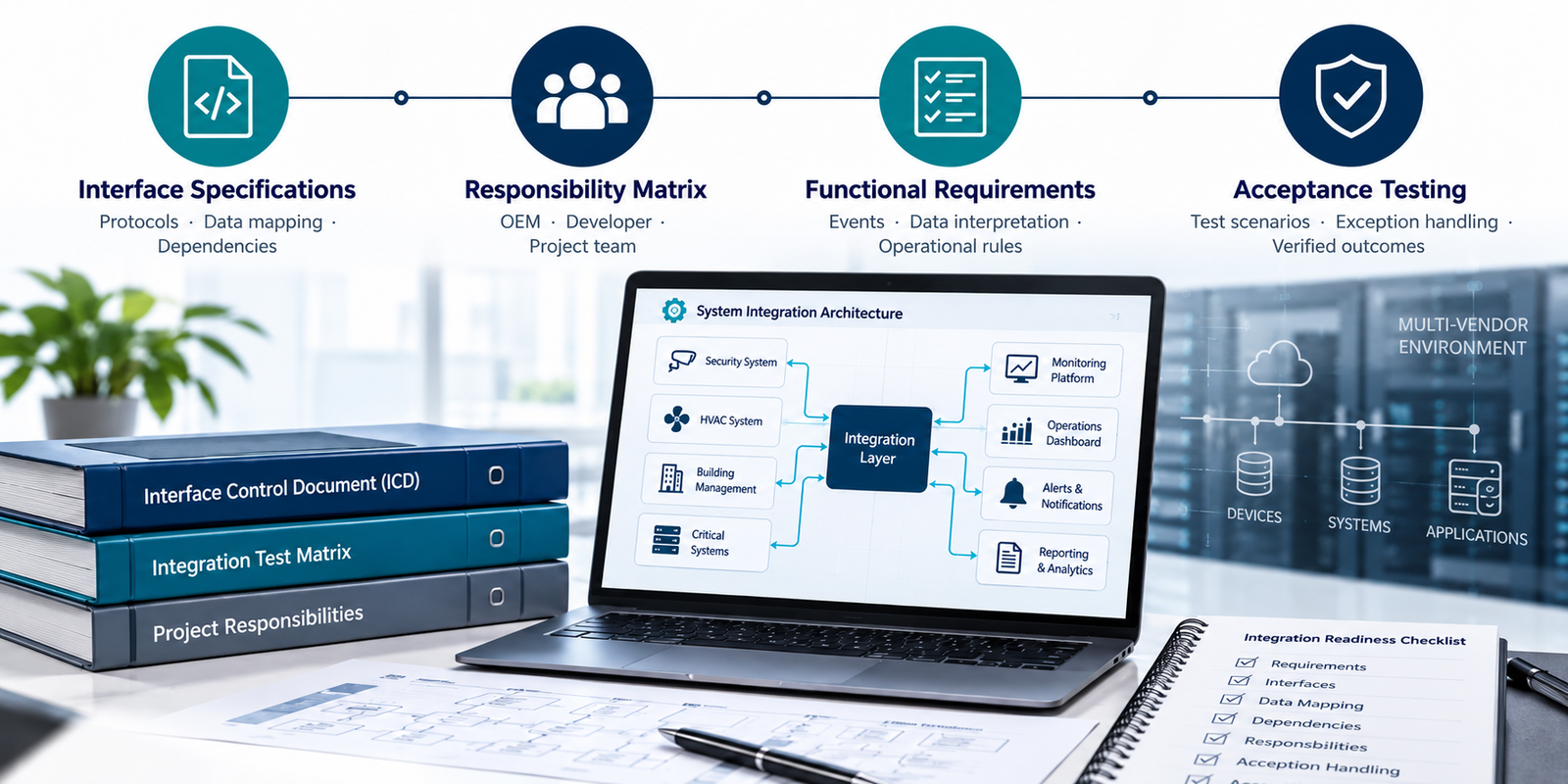
To minimize such gaps, projects benefit from three key documents:
Interface Control Document (ICD): Defines communication methods, message structures, data mappings, supported functions, and technical dependencies.
Responsibility Matrix: Identifies who provides interfaces, develops connectors, configures systems, and participates in testing.
Integration Test Matrix: Connects functional requirements to test scenarios, expected results, and acceptance evidence.
These documents help establish shared expectations before technical assumptions become commissioning problems.
When Is Custom Integration Engineering Required?
Not every integration requires custom software.
Standard interfaces, existing connectors, or supported configuration options may already satisfy the requirements.
Custom development becomes relevant when projects involve proprietary protocols, legacy technologies, incompatible data models, unsupported equipment, or specialized operational workflows.
The objective should be to select the most appropriate engineering approach rather than introduce unnecessary development.
Integration Readiness Checklist
Before implementation begins, project teams should confirm:
| Area | Key question |
|---|---|
| Requirements | Are the expected operational outcomes clearly defined? |
| Interfaces | Are the required protocols, APIs, and functions available? |
| Data | Are information structures and event mappings understood? |
| Dependencies | Are licensing, permissions, and version requirements confirmed? |
| Responsibilities | Is technical ownership assigned to each interface? |
| Exceptions | Are failure conditions and recovery behaviors defined? |
| Acceptance | Are functional test criteria documented? |
Unresolved items should be assessed before they become implementation risks.
Engineering for Operational Outcomes
Reliable integration is achieved when communication interfaces, data interpretation, operational logic, and acceptance criteria work together to satisfy defined requirements.
At Core Solutions & Technologies (CST), our Projects & Services division supports OEMs, system integrators, and technology partners with integration architecture, interface engineering, custom software development, and specialist technical services.
Whether supporting a defined integration work package or a broader technology project, our focus remains on practical engineering solutions.
Planning a multi-system integration?
Explore CST’s Complex Systems Integration and Software & Protocol Engineering capabilities, or contact us to discuss your project requirements.
About CST Pulse
CST Pulse is the technology insight platform of Core Solutions & Technologies, covering practical ICT and ELV topics for system integrators and technology partners across Middle East & Africa.
Bring your next project to the table.
Talk to CST about this technology or application.