
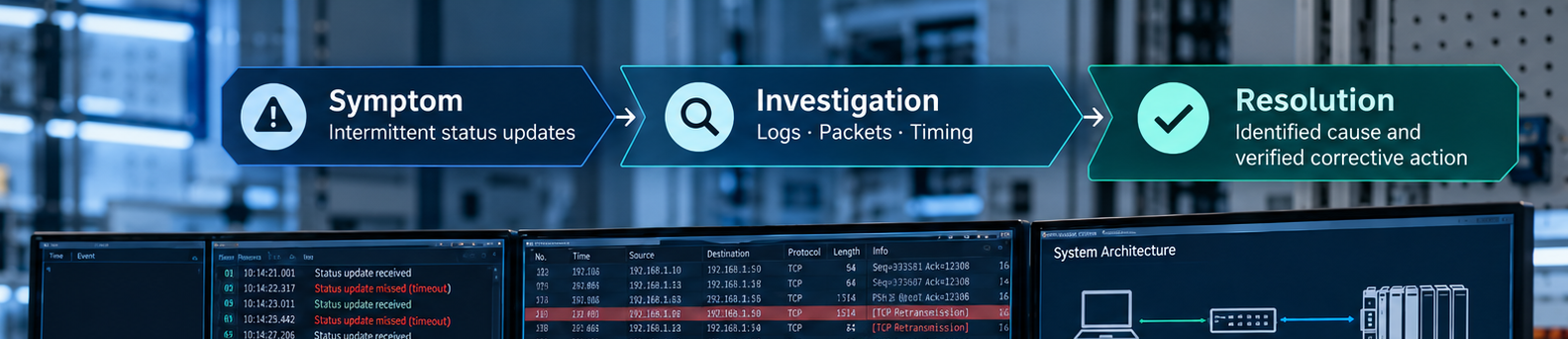
Understanding when complex technology problems require deeper technical investigation and targeted engineering expertise.
When a Technical Problem Goes Beyond Routine Support
Technology projects depend on equipment vendors, software providers, installation teams, and technical support personnel to keep systems operating correctly.
Most issues can be resolved through established procedures: checking configurations, reviewing logs, applying updates, replacing faulty components, or following manufacturer recommendations.
However, some problems do not fit neatly within standard troubleshooting procedures.
A device operates correctly when tested independently but behaves unpredictably when connected to another platform. A software application works in a laboratory but experiences intermittent failures at the project site. Multiple vendors confirm that their respective systems are functioning, yet the combined solution remains unreliable.
In such situations, the challenge may require specialist engineering expertise rather than another round of routine technical support.
Standard Technical Support vs. Specialist Engineering
Standard technical support generally addresses known product behavior, documented faults, configuration issues, and manufacturer-supported functionality.
Specialist engineering becomes relevant when the problem requires investigation beyond these boundaries.
This may involve examining communication protocols, analyzing network traffic, reviewing software behavior, evaluating integration architecture, or developing project-specific technical solutions.
The distinction is not simply the complexity of the equipment. It is the nature of the investigation required.
| Standard Technical Support | Specialist Engineering |
|---|---|
| Follows established troubleshooting procedures | Investigates problems without an established resolution |
| Focuses on supported product functionality | Examines interactions across technologies |
| Resolves known configuration or product issues | Analyzes complex or unexpected system behavior |
| Applies documented fixes and updates | May develop custom interfaces, logic, or technical modifications |
| Typically operates within vendor support boundaries | Can address defined engineering problems across multiple systems |
These approaches are complementary. Specialist engineers frequently depend on OEM documentation and vendor support when investigating complex technical issues.
Five Signs a Project May Need Specialist Engineering
1. The Problem Involves Multiple Vendors
When a fault spans several systems, each vendor may verify its own product without identifying the underlying cause.
Resolving the issue may require examining the complete communication sequence, system dependencies, and interactions between platforms.
2. The Problem Cannot Be Reproduced Consistently
Intermittent communication failures, timing-related issues, and unexpected event sequences can be difficult to diagnose using standard procedures.
Specialist investigation may require detailed logging, network packet analysis, controlled testing, and comparison of system behavior under different conditions.
3. Existing Interfaces Do Not Meet Project Requirements
A product may support an API or communication protocol but lack a function required by the project.
In such cases, engineers may need to evaluate alternative integration methods, develop an interface component, or identify an acceptable technical workaround.
Any proposed solution should respect manufacturer limitations, system security requirements, and operational safety constraints.
4. The Issue Appears Only During Integration or Commissioning
Individual subsystems may pass their respective tests while the combined solution fails during integration testing or site commissioning.
These problems often require investigation across software configuration, communication interfaces, infrastructure, and operational logic.
5. The Project Requires Expertise Outside the Existing Team
A project team may have strong capabilities in equipment installation, configuration, and project management but lack specialist knowledge of a particular protocol, software interface, or integration platform.
Engaging targeted engineering support can address that requirement without replacing the established delivery team.
Practical Example: An Intermittent Integration Failure
Consider a centralized monitoring application receiving status information from an industrial controller through a middleware component.
The controller manufacturer confirms that its device communicates correctly. The software provider verifies that the monitoring application processes valid messages as expected.
Yet the application occasionally displays outdated device status.
A specialist engineering investigation might examine message timestamps, polling intervals, communication delays, middleware processing, and reconnection behavior.
By capturing and comparing communication data across the participating components, engineers can determine where information becomes delayed or inconsistent.
The root cause might involve message buffering, timing assumptions, network conditions, configuration differences, or application logic.
The appropriate corrective action depends on evidence collected during the investigation.
This scenario illustrates why complex technical problems should be examined across the complete interaction rather than assigned prematurely to one product or vendor.
How to Structure a Specialist Engineering Engagement
Effective engineering support begins with a clearly defined technical problem and access to relevant evidence.
Before starting an investigation, the project team should establish:
- Problem statement: What behavior is expected, and what is actually occurring?
- System boundaries: Which platforms, devices, interfaces, and infrastructure are involved?
- Available evidence: What logs, configurations, documentation, and previous test results exist?
- Technical access: Are the necessary systems, test environments, and OEM resources available?
- Expected deliverables: Is the requirement for diagnosis, corrective development, configuration changes, or technical recommendations?
The outcome may be a root-cause report, corrected integration component, updated configuration, technical recommendation, or verified resolution.
A focused engagement can help project stakeholders make informed decisions without unnecessarily expanding the engineering scope.
Specialist Engineering as an Extension of the Project Team
Specialist engineering does not have to mean transferring responsibility for the entire project to another organization.
OEMs, system integrators, and contractors can engage external expertise for a specific technical assignment while retaining their existing project structure and customer relationships.
At Core Solutions & Technologies (CST), our Projects & Services division supports technology partners through technical assessments, integration diagnostics, software and protocol engineering, troubleshooting, testing, and project-specific engineering assistance.
Our approach is to understand the technical challenge, define the required engineering work, and support the existing project team in achieving a practical outcome.
Facing a technical challenge that routine support has not resolved?
Explore CST’s Specialist Engineering Services capabilities or contact our team to discuss a defined engineering requirement.
About CST Pulse
CST Pulse is the engineering and technology insight platform of Core Solutions & Technologies, covering practical ICT & ELV and Engineering Projects topics for OEMs, system integrators, technology partners and end customers across Middle East & Africa.
Bring your next project to the table.
Talk to CST about this technology or application.