
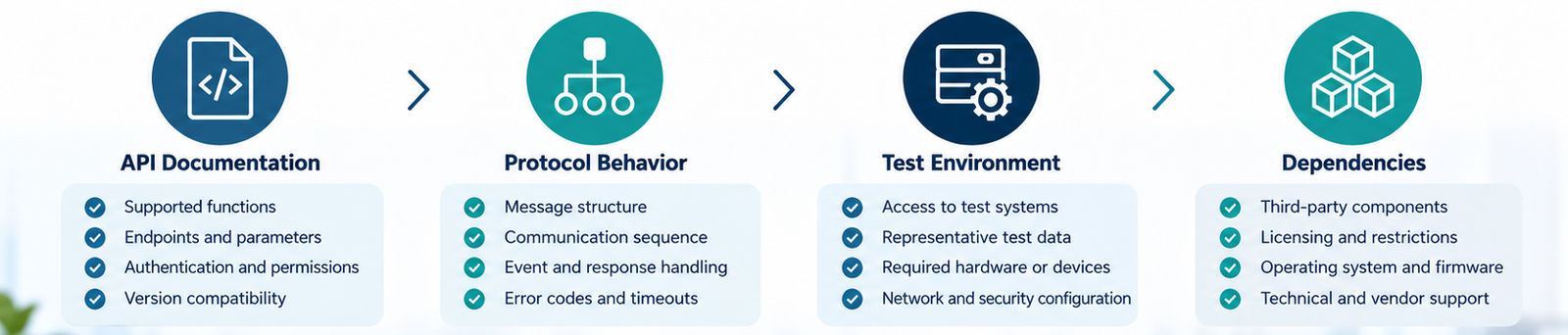
How early technical assumptions, incomplete interface information, and unverified dependencies affect software integration projects.
The Challenge Before the First Line of Code
Software integration projects often appear straightforward during initial discussions.
One system exposes an API, another supports external communication, and a development team is assigned to build the interface.
The technical requirements seem manageable until implementation begins.
A required function may not be exposed through the available API. A protocol document may describe message formats without explaining device behavior. Access to the target environment may depend on licensing, permissions, or firmware versions that have not been confirmed.
These issues are frequently discovered after development has started, leading to additional investigation, design changes, and project delays.
Many software integration challenges originate in assumptions made before implementation, not necessarily in the software code itself.
API Availability Does Not Guarantee Integration Readiness
An API provides a mechanism for interacting with a software platform, but its existence does not confirm that the required functionality is available.
An interface may support reading device status but not changing it. It may provide historical events without supporting real-time notifications. Some functions may require additional licensing, privileges, or platform-specific configuration.
Before committing to development, engineers need to establish what the interface actually supports.
This requires more than receiving an API document. It may involve reviewing supported operations, testing sample requests, examining response structures, and confirming behavior against the required software or firmware versions.
A small technical investigation at this stage can reveal limitations that would otherwise affect the entire integration design.
Four Common Problems That Delay Interface Development
1. Incomplete or Outdated Documentation
Interface documentation may omit error responses, optional parameters, authentication behavior, or restrictions that only become apparent during testing.
In proprietary protocol environments, documentation may explain packet structures without fully describing communication sequences or device state transitions.
Developers are then required to investigate behavior that should ideally have been defined before implementation.
2. Unavailable Test Environments
Integration development becomes difficult when engineers cannot access a representative instance of the target system.
A production environment may be unavailable for testing, while a simulator may not reproduce every response or operational condition.
For integrations involving physical equipment, access to the actual controller or device may be necessary to verify specific behaviors.
The project should establish suitable testing arrangements early, including access credentials, test data, equipment availability, and environmental dependencies.
3. Unclear Functional Boundaries
Different platforms may have different responsibilities for generating events, processing commands, maintaining device states, or acknowledging transactions.
Without defined functional boundaries, developers may implement logic that conflicts with existing system behavior or leaves gaps between platforms.
For example, if a command request is acknowledged, does that mean the receiving system accepted the request, or that the physical operation was completed successfully?
The distinction affects how the interface should be designed and tested.
4. Unverified Dependencies
Software integrations may depend on operating system versions, communication libraries, network configurations, database access, third-party licenses, or manufacturer-specific components.
These dependencies can influence architecture, development effort, deployment and maintenance.
Identifying them before development begins helps avoid designing an interface around assumptions that later prove incorrect.
A Practical Example: Integrating a Legacy Controller
Consider a project requiring a modern monitoring application to communicate with an older equipment controller.
The controller supports serial communication through a proprietary protocol.
Initially, the requirement appears to involve reading equipment status and sending a limited set of commands.
However, development cannot be planned accurately until several details are established:
- How does the controller structure requests and responses?
- Does it respond to unsolicited events or only to polling?
- What happens when a command is rejected or times out?
- How are communication errors identified?
- Are different firmware versions behaviorally consistent?
- Is a physical controller available for testing?
The answers determine whether development involves a straightforward protocol handler or additional work such as message sequencing, state management, communication recovery, and device-specific validation.
The important engineering activity occurs before the connector is written: understanding what the existing technology actually requires.
What Should Be Confirmed Before Development Starts?
A short technical discovery exercise can help establish a more reliable development baseline.
| Area | Information to confirm |
|---|---|
| Functional scope | Required events, commands, data and expected behavior |
| Interface availability | Supported APIs, protocols, SDKs and access permissions |
| Documentation | Message formats, operations, errors and limitations |
| Environment | Software versions, devices, test systems and connectivity |
| Dependencies | Licensing, libraries, configurations and third-party components |
| Validation | Test scenarios, expected responses and acceptance criteria |
Not every unknown must be resolved immediately. However, significant uncertainties should be identified, assigned ownership and addressed through documentation, technical investigation or a proof of concept.
This helps distinguish known development requirements from technical risks that still require investigation.
Better Preparation Leads to More Predictable Engineering
Software development is only one part of delivering a successful integration.
Interface assessment, technical discovery, environment preparation and dependency verification all influence the engineering effort required.
Early preparation does not eliminate every integration challenge. It does, however, make the work more predictable and helps project teams recognize where additional engineering or vendor support may be necessary.
At Core Solutions & Technologies (CST), our Projects & Services division supports OEMs, system integrators and technology partners through software and protocol engineering, custom connector development, interface analysis and integration troubleshooting.
Our focus is on understanding the technical requirements before selecting and implementing an appropriate engineering solution.
About CST Pulse
CST Pulse is the engineering and technology insight platform of Core Solutions & Technologies, covering practical ICT & ELV and Engineering Projects topics for OEMs, system integrators, technology partners and end customers across Middle East & Africa.
Bring your next project to the table.
Talk to CST about this technology or application.