
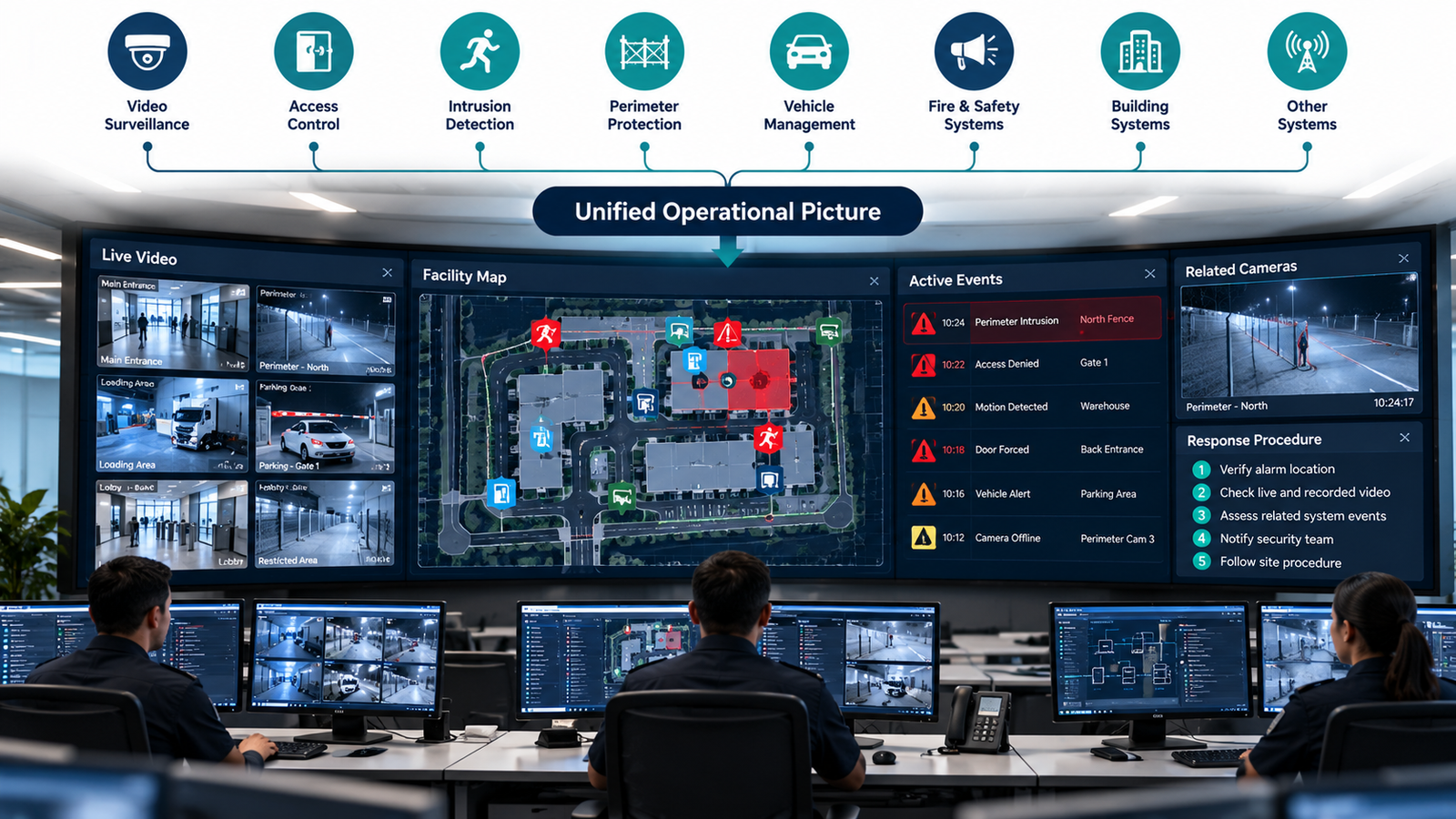
How centralized security monitoring, event correlation, and coordinated workflows can improve situational awareness in complex facilities.
The Challenge of Fragmented Security Operations
A modern facility may have several security technologies working simultaneously: video surveillance, access control, intrusion detection, perimeter protection, and vehicle entrance systems.
Each technology serves a specific purpose. However, when an incident occurs, security personnel may need to consult multiple applications to understand what is happening.
An access control alarm appears on one workstation. Relevant camera footage is available through another application. A perimeter system reports a separate event, while the status of a nearby vehicle barrier must be checked elsewhere.
The information exists, but it is distributed across independent systems.
The operational challenge is not simply collecting more information. It is making relevant information available in context so operators can assess an incident and respond appropriately.
This is where a unified operational picture becomes valuable.
What Is a Unified Operational Picture in Security?
A unified operational picture is a consolidated view of relevant security information from multiple sources, presented in a form that supports monitoring, incident assessment, and coordinated response.
Depending on the environment, it may include alarm information, device status, camera views, location references, event histories, and predefined response procedures.
A unified view does not necessarily require replacing existing security platforms. Instead, supported interfaces can allow information from different systems to be presented and managed through a common operational environment.
Physical Security Information Management (PSIM) and command-and-control platforms are among the technologies used to support this approach.
However, the value of such a platform depends on how accurately information is interpreted, related, prioritized, and presented to operators.
Three Ways a Unified Operational Picture Supports Security Teams
1. Faster Access to Relevant Information
During an incident, operators need information that helps them understand the situation, not simply a longer list of alarms.
A centralized operational platform may associate an access control event with the affected entrance, relevant surveillance cameras, and the status of nearby security equipment.
This can reduce the need to manually locate information across different applications.
The effectiveness of this approach depends on accurate device mapping, current information, and suitable integration capabilities.
2. Better Context Through Event Correlation
Security systems often generate events independently, even when several events relate to the same physical incident.
For example, a perimeter alarm may be followed by motion detection from a nearby camera and an access control event at an adjacent gate.
Individually, these events provide limited context.
When appropriate relationships are defined, event correlation can help operators recognize that multiple notifications may be associated with one developing situation.
Correlation must be engineered carefully. Incorrect relationships, excessive automation, or poor event filtering may generate misleading conclusions rather than useful situational awareness.
3. More Consistent Incident Response
Organizations often have established procedures for responding to security events.
A centralized platform can help operators follow these procedures by presenting relevant instructions, escalation contacts, incident information, and available system actions.
For example, a predefined workflow might prompt an operator to verify the affected location, review associated video, acknowledge an alarm, and notify the responsible security personnel.
Where supported and authorized, the platform may also enable specific control actions.
The objective is not to remove human judgment. It is to make the required information and procedures easier to access during operational situations.
Practical Scenario: An Incident at a Restricted Entrance
Consider a large industrial facility with several restricted access points.
An access control system reports repeated denied-entry attempts at one entrance.
Without centralized coordination, an operator may need to identify the entrance, locate the associated camera, review the video, and check whether any related alarms have occurred.
Within a suitably integrated operational platform, the same event could present:
- The entrance location and associated access point.
- Relevant live or recorded video, subject to system capabilities.
- The event category, timestamp, and device status.
- Related alarms from nearby equipment.
- The applicable operator response procedure.
This does not guarantee that the incident will be resolved more quickly. However, it can reduce unnecessary information gathering and give the operator a clearer starting point for assessment.
The quality of the result depends on correct interface implementation, event mappings, system availability, and operational configuration.
What Makes Centralized Security Integration Effective?
Implementing a unified operational picture requires more than displaying multiple systems on one dashboard.
Several engineering considerations influence its effectiveness.
Accurate event interpretation: Events must retain the correct meaning, priority, source, and operational context when transferred between platforms.
Reliable asset and location mapping: Cameras, doors, sensors, and other devices must be associated with the correct physical areas and operational assets.
Appropriate alarm prioritization: Operators should be able to distinguish critical situations from routine notifications without losing important information.
Defined response workflows: Escalation procedures, operator actions, and automated functions should reflect the facility’s approved security operations.
System resilience and diagnostics: Communication failures, missing events, unavailable devices, and other integration problems should be detectable and appropriately reported.
Operational validation: Testing should confirm that integrated scenarios behave correctly under realistic conditions, including relevant abnormal and failure scenarios.
These considerations are particularly important in multi-vendor environments, where individual systems may represent events and status information differently.
Does Every Facility Need a PSIM Platform?
Not necessarily.
The appropriate approach depends on the number and complexity of security systems, operational requirements, existing technology capabilities, and the level of coordination required.
A smaller facility may achieve its objectives through native integrations available within existing security management applications.
Larger or more complex environments may benefit from dedicated PSIM or command-and-control capabilities, particularly where multiple technologies, locations, and incident procedures must be coordinated.
The decision should begin with operational requirements rather than an assumption that every security environment needs another software platform.
Engineering Around the Operator’s Needs
A unified operational picture should help security teams interpret situations, access relevant information, and follow appropriate response procedures.
Its effectiveness depends on a combination of technology selection, interface engineering, event handling, workflow design, and operational testing.
At Core Solutions & Technologies (CST), our Projects & Services division supports OEMs, system integrators, and end customers with security subsystem interfaces, PSIM integration, event correlation, and specialist engineering support.
Our focus is on helping established technologies operate together in ways that address defined security requirements.
Looking to improve coordination across existing security systems?
Explore CST’s Security Systems Integration capabilities or contact our team to discuss a specific integration requirement.
About CST Pulse
CST Pulse is the engineering and technology insight platform of Core Solutions & Technologies, covering practical ICT & ELV and Engineering Projects topics for OEMs, system integrators, technology partners and end customers across Middle East & Africa.
Bring your next project to the table.
Talk to CST about this technology or application.