
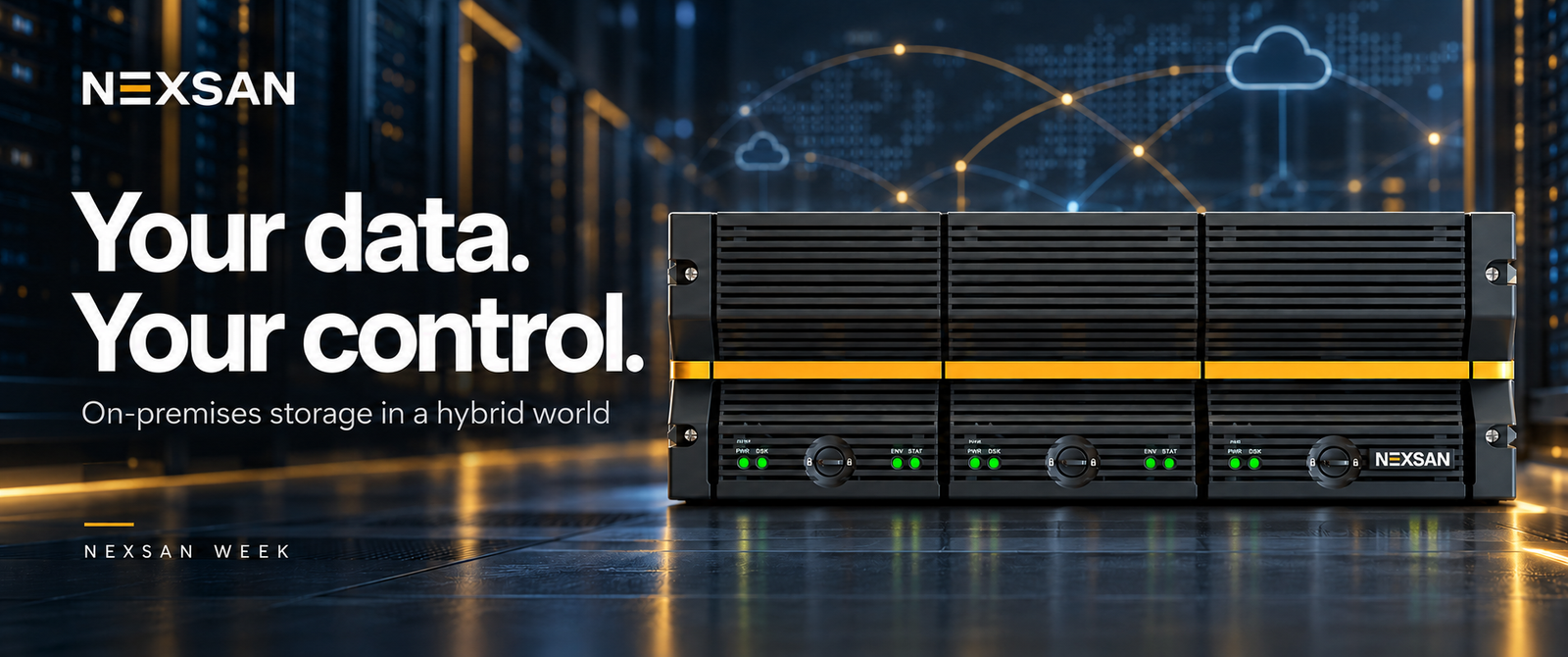
On-premises storage deserves a place in every enterprise data strategy, especially when the business needs direct control over sensitive information, dependable local access and a practical recovery plan.
The cloud offers valuable flexibility. However, moving data off-site does not remove the need to decide who controls it, how applications reach it and how the organization recovers it.
Before choosing a platform, ask a more useful question:
Which data must remain close to the business—and why?
Start with the workload, not the storage location
A hospital’s imaging archive, a manufacturer’s production files and a company’s collaboration documents serve different needs. Therefore, they should not automatically follow the same storage policy.
First, identify who uses each dataset and where the application runs. Next, establish its sensitivity, growth rate and retention period. Finally, agree how much downtime and data loss the business can tolerate.
These answers give system integrators a stronger design brief than capacity alone.
On-premises storage gives control a practical meaning
Control involves more than knowing which room holds the equipment. It also covers administrator privileges, encryption keys, retention rules, monitoring and access to recovery copies.
With on-premises infrastructure, the organisation can manage those decisions directly. For example, it can separate storage administration from backup administration and align maintenance with local operations.
However, ownership brings responsibility. The design still needs secure configuration, updates, physical protection and people who can operate it.
Cloud services can also provide strong controls. Therefore, compare the actual access model and operating responsibilities rather than assuming either location guarantees security.
How connectivity shapes on-premises storage decisions
Consider a site that produces large files throughout the day. If its applications and users work locally, sending every transaction across a wide-area connection may add avoidable dependency.
Local storage can keep those data paths on the local network. As a result, suitable workloads can continue during an internet disruption, provided their applications, identity services and other dependencies remain available.
However, a local array cannot keep a cloud-hosted application running by itself. Likewise, remote branches still need reliable connectivity to reach a central data centre.
For projects across East Africa and Nigeria, assess each site’s bandwidth, latency, link resilience and power provision. Measure the actual environment rather than making a regional assumption.
Recovery needs more than a stored copy
A backup matters only when the business can use it to restore service.
First, define the recovery time objective: how quickly must operations resume? Then define the recovery point objective: how much recent data can the business afford to lose?
A local recovery copy may reduce dependence on WAN transfer during a large restore. However, recovery also needs clean data, available compute, working applications and tested procedures.
In addition, protect against the loss of the entire site. Use an appropriately isolated off-site copy, a second location or a suitable cloud recovery design.
Immutable protection can help preserve recovery data against alteration or deletion. Nevertheless, it complements access controls and recovery testing; it does not replace them.
Sensitive data needs a complete control plan
Personnel records, customer files, research and operational archives may require different levels of protection.
For each dataset, identify who can access it, who controls the keys and how long the business needs to retain it. Also check where backup copies, replicas and support access fit into that plan.
Local placement may support the organisation’s requirements. However, location alone does not establish compliance. Confirm applicable obligations for the specific country, sector and dataset before finalising the design.
Compare on-premises storage and cloud lifetime costs
A hardware quotation and a monthly cloud bill describe different parts of the cost picture.
For on-premises storage, include usable capacity, resilience, support, power, cooling, rack space, administration and eventual refresh. Also include the separate infrastructure needed for backup and disaster recovery.
For cloud storage, include the selected service tier, requests, retrieval, data transfer where applicable, connectivity, protection and management. Then model routine access alongside a large recovery or migration.
Consequently, the useful comparison is the total cost of meeting the same service requirements over the same period.
Predictable, substantial local workloads may justify owned infrastructure. Conversely, variable demand and cloud-hosted applications may favour cloud services. The workload model should establish the answer.
Where Nexsan fits
Nexsan provides distinct platforms for different storage roles:
- E-Series: enterprise block storage for SAN environments.
- Unity: unified block, file and S3 object storage, with immutable snapshots.
- Assureon: immutable storage focused on protected retention and data integrity.
These roles help an integrator separate live application storage from recovery and long-term retention requirements. However, the final design must confirm the chosen model, configuration and protection features.
For example, a business might keep latency-sensitive applications and their primary data locally, maintain a protected off-site copy, and use cloud services for suitable collaboration or analytics workloads.
That is a hybrid strategy with a clear purpose.
Begin with five decisions
Before the next storage quotation, agree:
- Which data requires direct operational control?
- Which workloads must continue through a WAN disruption?
- How quickly must each service recover?
- Which information needs stronger retention and access controls?
- What will the complete design cost over its planned life?
At Core Solutions & Technologies, we help system integrators connect these requirements with the appropriate Nexsan storage approach. Bring us the workload, growth forecast and recovery targets, and let’s build the discussion from there.
About CST Pulse
CST Pulse is the technology insight platform of Core Solutions & Technologies, covering practical ICT and ELV topics for system integrators and technology partners across Middle East & Africa.
Bring your next project to the table.
Talk to CST about this technology or application.