
How poorly defined technical ownership creates rework, project delays, and commissioning challenges—and what project teams can do to prevent them.
When Everyone Delivers Their Scope, but the Solution Still Doesn’t Work
Consider a technology project involving several equipment manufacturers, software providers, and implementation contractors.
Each supplier delivers its respective equipment or software. Individual subsystems pass their functional tests, and installation activities progress according to plan.
However, during integration testing, the combined solution fails to operate as intended.
One supplier expects the other to develop the interface. Another assumes the required data mapping is already available. The software provider requires additional information that was never included in the original scope.
Suddenly, a project that appeared technically complete faces additional engineering work, commercial discussions, and potential delays.
The underlying problem may not be a product failure. It may be an integration responsibility that was never clearly assigned.
Why Integration Responsibilities Become Unclear
Multi-vendor projects are typically divided into contractual packages covering different technologies and deliverables.
This structure makes commercial and project management sense, but it can introduce gaps between individual scopes.
For example, an access control vendor may be responsible for providing an API, while a central monitoring platform requires a connector to consume that API.
Who develops the connector? Who defines the event mapping? Who configures the interfaces? Who verifies that the resulting functionality meets operational requirements?
If these responsibilities are not explicitly established, each party may reasonably believe the work belongs elsewhere.
The problem becomes more complicated when interface development, licensing, equipment availability, and testing support involve separate organizations.
The Hidden Costs of Undefined Technical Ownership
1. Unplanned Engineering Effort
Integration gaps discovered during execution often require additional software development, configuration, testing, or technical investigation.
If the work was not included in the original scope, the project may require variation orders, additional resources, or commercial negotiations.
2. Delays During Critical Project Stages
Integration problems frequently become visible during testing and commissioning, when multiple systems are expected to function together.
Resolving unclear responsibilities at this stage can affect planned acceptance activities, commissioning sequences, and operational handover.
3. Repeated Testing and Rework
When interface behavior has not been agreed, different teams may implement conflicting assumptions.
Correcting those assumptions can require changes to software, configurations, data mappings, and test procedures.
Previously completed testing may also need to be repeated.
4. Extended Fault Investigation
A communication failure involving multiple technologies can lead to separate investigations by each vendor.
Without agreed technical ownership and a coordinated diagnostic approach, considerable time may be spent determining who should investigate the issue rather than identifying its cause.
5. Commercial and Contractual Disputes
When responsibility is ambiguous, technical problems can develop into disagreements over scope, additional costs, acceptance obligations, and project delays.
Clear interface responsibilities cannot eliminate every dispute, but they provide a stronger basis for technical and commercial decisions.
Practical Example: Integrating a Central Monitoring Platform
Consider a facility deploying a centralized monitoring platform that must receive alarms from multiple third-party systems.
The subsystem suppliers agree to make their interfaces available. The platform provider agrees to configure the monitoring application.
During implementation, the project team discovers that the available interfaces expose raw event codes rather than the operational information expected by the central platform.
Additional engineering is required to translate event codes, associate devices with locations, and define alarm classifications.
However, the original project documents do not identify who is responsible for this translation.
The technical requirement may be straightforward, but the absence of assigned responsibility introduces an unexpected commercial and scheduling problem.
Had the interface functionality and ownership been defined during project planning, the required development could have been included in the appropriate work package.
Four Practices That Improve Integration Accountability
1. Define Interface Deliverables, Not Just System Boundaries
Project scopes should identify more than the equipment or platforms each supplier provides.
They should also define required integration deliverables, including interfaces, connectors, configuration, data mappings, documentation, and testing support.
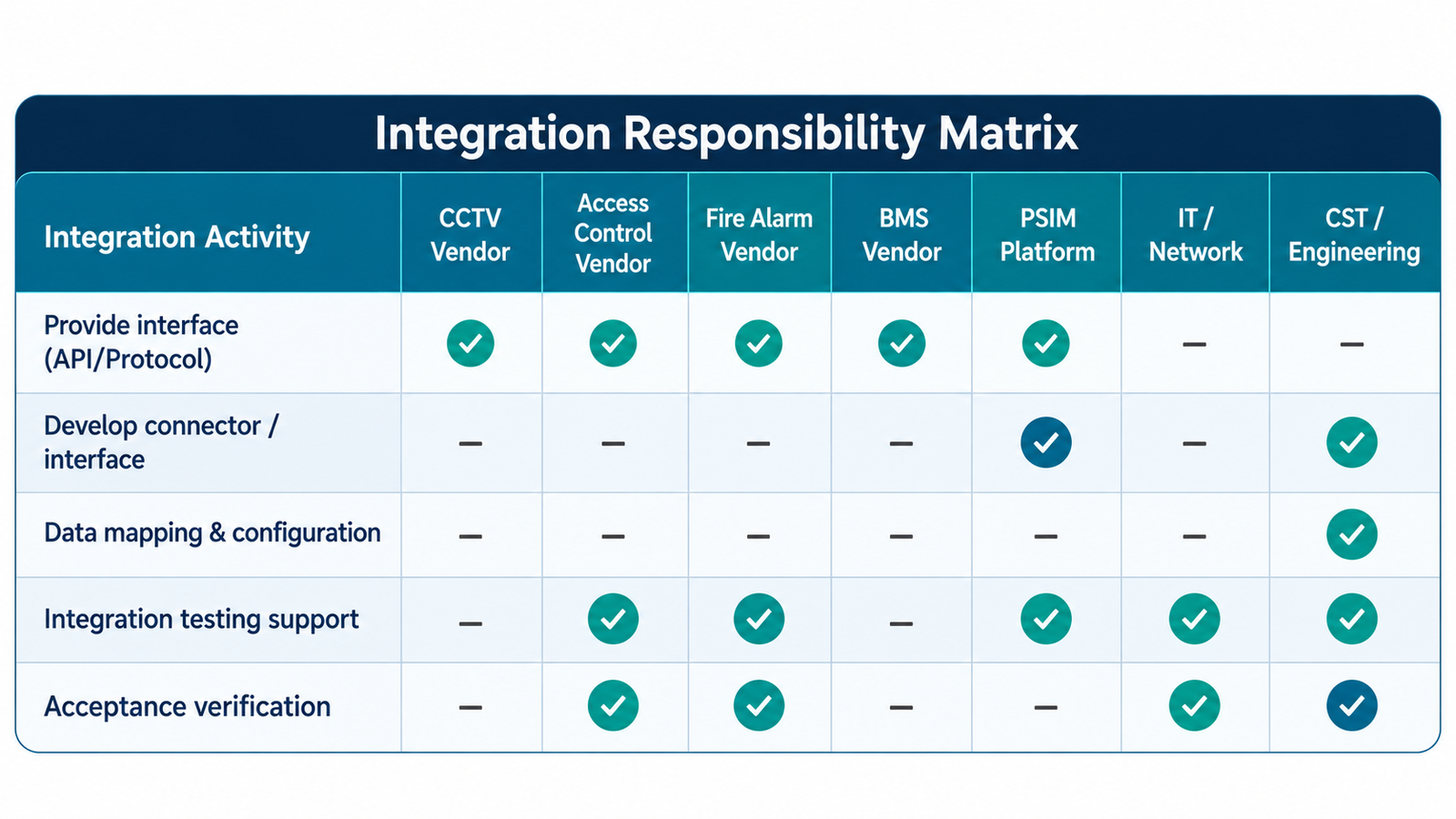
2. Establish a Responsibility Matrix
A responsibility matrix should identify which organization is accountable for each integration activity and which parties provide technical information or support.
This is particularly important when multiple vendors contribute to a single operational workflow.
3. Agree on Interface Acceptance Criteria
Acceptance criteria should describe expected system behavior and identify how successful integration will be demonstrated.
This helps prevent disagreements about whether providing an API, delivering a connector, or completing configuration constitutes fulfillment of the integration requirement.
4. Review Integration Dependencies Before Execution
Project teams should verify API availability, licensing, software compatibility, required development resources, and access to representative test environments.
Dependencies involving multiple parties should have identified owners and agreed resolution plans.
Where Specialist Engineering Support Adds Value
Not every system integrator or contractor maintains in-house expertise for every technology, protocol, and software interface encountered in a project.
Specialist engineering partners can undertake defined integration packages, investigate technical problems, develop interface components, or support integration testing.
This approach allows the primary project organization to retain its existing customer relationships and delivery responsibilities while accessing the expertise needed for specific technical requirements.
At Core Solutions & Technologies (CST), our Projects & Services division supports OEMs, system integrators, and project contractors through interface engineering, integration development, technical troubleshooting, and project delivery assistance.
Our engagement model is designed to complement existing project teams and provide clearly defined technical deliverables.
Managing a project with complex third-party interfaces?
Explore CST’s Complex Systems Integration and Technology Project Delivery capabilities, or contact our team to discuss a specific integration work package.
About CST Pulse
CST Pulse is the engineering and technology insight platform of Core Solutions & Technologies, covering practical ICT & ELV and Engineering Projects topics for OEMs, system integrators, technology partners and end customers across Middle East & Africa.
Bring your next project to the table.
Talk to CST about this technology or application.